
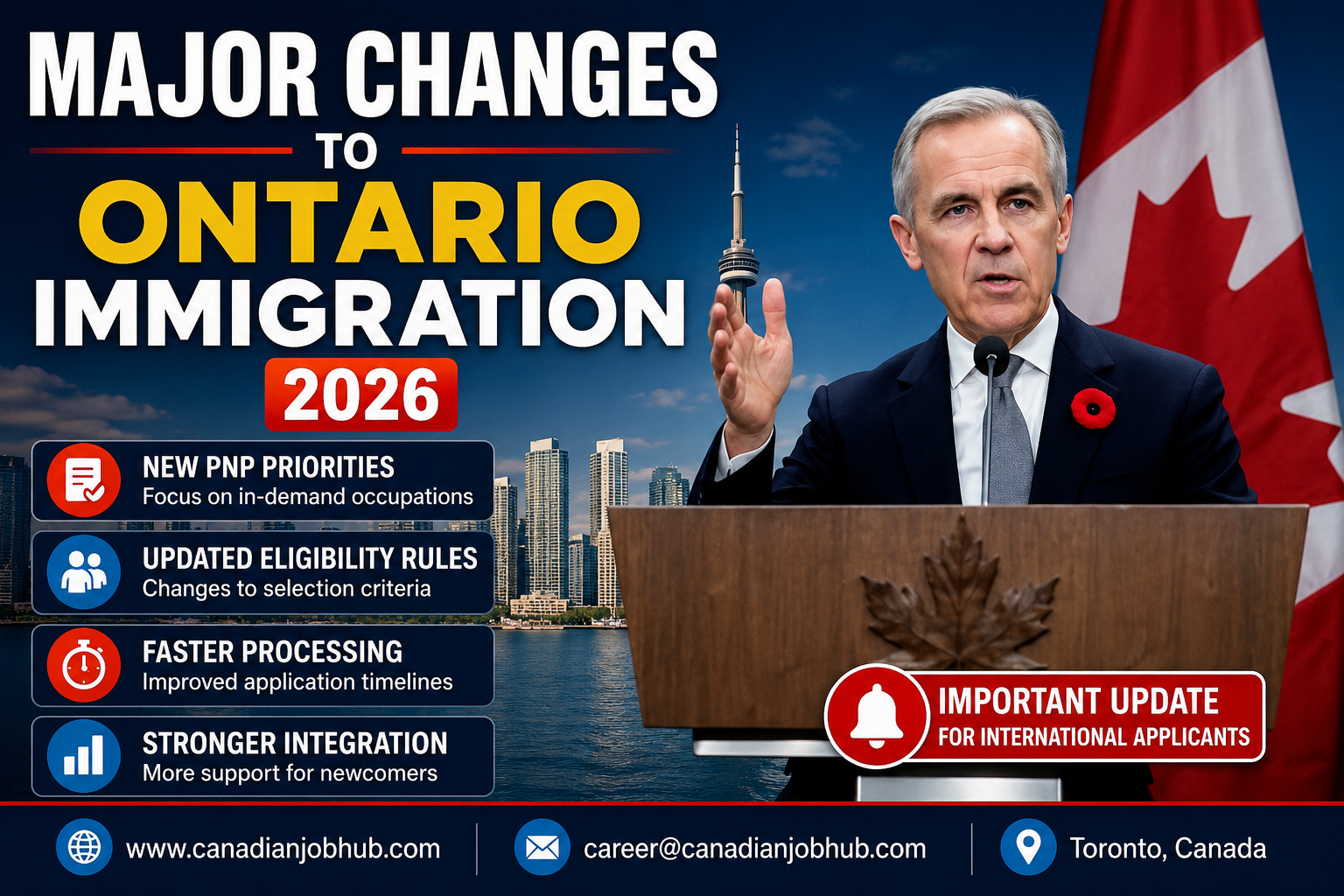
Ontario has made one of the most significant changes to its provincial immigration system in 2026.
The Ontario Immigrant Nominee Program (OINP) has been redesigned to focus more directly on Ontario’s labour-market needs, employers with hard-to-fill positions, regional economic priorities and program integrity.
The biggest change is the introduction of the Ontario Workforce Priority Stream. Ontario announced that the new stream would replace the previous OINP structure, and as of August 4, 2026, the province opened its Expression of Interest (EOI) portal for the new stream.
This is important for foreign workers, international graduates, employers and immigration applicants who previously planned to use Ontario’s Employer Job Offer, Master’s Graduate, PhD Graduate or Express Entry-linked OINP pathways.
The old system is no longer the system applicants should rely on for new applications.
Ontario announced on June 26, 2026 that the redesign closed the existing eight streams and introduced the new Ontario Workforce Priority Stream. The province says the redesign is intended to streamline pathways for people with arranged employment, help employers retain proven talent in difficult-to-fill positions, raise language and education benchmarks and improve access for rural and northern employers.
For anyone planning to immigrate to Ontario in 2026, understanding these changes is essential.
What Is the Ontario Immigrant Nominee Program?
The Ontario Immigrant Nominee Program is Ontario’s economic immigration program.
It allows the province to nominate eligible foreign nationals for Canadian permanent residence based on provincial economic and labour-market needs.
However, Ontario does not make the final permanent residence decision.
After receiving an Ontario nomination, the applicant must complete the federal permanent residence process with Immigration, Refugees and Citizenship Canada (IRCC). Ontario explains that the province nominates candidates while the Government of Canada makes the final decision on permanent residence.
This means there are two major stages:
Stage 1: Ontario nomination
Stage 2: Federal permanent residence application
The 2026 changes mainly affect the first stage.
Click Here: Canada Cybersecurity Jobs 2026 High Salary, Demand, Work Visa & PR Guide
The Biggest Ontario Immigration Change in 2026
The most important development is the replacement of the previous OINP stream structure.
Ontario announced that the following eight streams were closed as part of the redesign:
- Employer Job Offer: Foreign Worker
- Employer Job Offer: In-Demand Skills
- Employer Job Offer: International Student
- Master’s Graduate
- PhD Graduate
- Express Entry Human Capital Priorities
- Express Entry French-Speaking Skilled Worker
- Express Entry Skilled Trades
These closures took effect as part of the regulatory changes that came into force on June 25, 2026.
This is a major change because applicants can no longer assume that the old OINP categories will reopen for new applicants.
Instead, Ontario has moved toward a more flexible workforce-priority model.
What Is the New Ontario Workforce Priority Stream?
The Ontario Workforce Priority Stream is the centerpiece of Ontario’s redesigned immigration system.
It provides eligible skilled foreign workers with a qualifying Ontario job offer a pathway toward permanent residence.
The stream also includes a pathway for eligible self-employed physicians who do not have a job offer.
One particularly important feature is that job offers can cover occupations across all NOC TEER categories.
That means the new structure is broader than a system limited only to highly skilled occupations.
Ontario’s employer portal guidance confirms that employers can submit job offers under the Workforce Priority Stream for NOC occupations in TEER categories 0 through 5.
This does not mean every job automatically qualifies.
The employer, position and applicant must still satisfy the applicable requirements.
Why Ontario Changed Its Immigration System
Ontario says the redesign is intended to make the provincial immigration system more responsive to changing labour-market needs.
The province highlighted several objectives:
- Streamlining pathways to permanent residence
- Helping employers retain proven talent
- Addressing hard-to-fill positions
- Raising language and education standards
- Improving program integrity
- Supporting rural and northern communities
- Giving Ontario greater flexibility to respond to labour-market changes
This represents an important shift in strategy.
Rather than relying heavily on a fixed collection of immigration streams, Ontario is moving toward a model in which the province can target labour-market priorities more directly.
Ontario Workforce Priority Stream: Who Can Benefit?
The new stream can potentially benefit several groups.
1. Foreign Workers With Ontario Job Offers
A skilled foreign worker with a qualifying Ontario job offer may be able to register an EOI.
The employer must first initiate the process through the employer portal.
After the employer submits the required job-offer information, the candidate receives the information needed to register an Expression of Interest.
2. Workers in Different TEER Categories
The new structure covers positions across NOC TEER categories.
Ontario’s employer portal allows employers to submit Workforce Priority job offers under TEER 0–5.
This is significant because the former OINP system had specific occupational and stream requirements.
Under the new system, the focus can be more flexible and responsive to Ontario’s actual workforce requirements.
3. Self-Employed Physicians
The new stream also includes eligible self-employed physicians.
This is a separate pathway from the job-offer route.
Physicians should carefully review the current professional licensing and stream requirements before submitting an EOI.
Ontario Immigration EOI System in 2026
The Expression of Interest system is central to the new process.
An EOI is not the same thing as an immigration application.
Instead, it tells Ontario that you want to be considered for an invitation.
Ontario states that candidates must register an EOI before they can apply through the applicable OINP pathway and that applicants can only apply after receiving an invitation.
The process generally works like this:
Employer submits job offer → Candidate receives job-offer information → Candidate registers EOI → Ontario selects candidates → Invitation to Apply → Application submitted → Ontario assesses nomination → Federal PR application
Important: An EOI Does Not Guarantee an Invitation
One of the biggest misunderstandings about the Ontario immigration system is confusing an EOI with an application.
Submitting an EOI does not mean you have been nominated.
It does not guarantee an invitation.
It does not guarantee permanent residence.
Ontario reviews the pool and selects candidates based on program priorities and applicable criteria.
Therefore, applicants should not make major financial or relocation decisions simply because they have registered an EOI.
Ontario’s New Focus on Employers
The 2026 changes put a strong emphasis on the employer.
For a foreign worker using the Workforce Priority Stream, the employer must initiate the process through the employer portal.
The employer must provide information about the position and submit the job offer.
After submission, the employee receives a job-offer ID and can proceed with the EOI process.
This makes the employer an important part of the immigration process.
Foreign workers should therefore focus on finding legitimate Ontario employers rather than simply searching for an immigration program.
Job Offer Requirements Under the New System
A qualifying job offer is one of the most important parts of the Workforce Priority Stream.
Ontario’s regulatory framework establishes wage requirements for qualifying positions.
The regulation states that the position generally must meet at least the median wage level applicable to the occupation and region according to Canada’s Job Bank and Canadian Job Hub on the day the application is made.
A specific exception can apply to certain recent Ontario graduates in the TEER 0–3 category, where the applicable low wage level may be used.
This means applicants should not rely on an arbitrary salary figure.
The relevant wage can depend on:
- Occupation
- Region
- NOC
- Canadian Job Hub
- Job Bank wage data
- Applicant category
- Date of application
Applicants should verify the applicable wage at the time they apply.
New Language and Education Emphasis
Ontario has also indicated that the redesigned system will introduce elevated language and education benchmarks.
The province says these changes are intended to strengthen the calibre of nominees and program integrity.
This is important for applicants who previously assumed that meeting a basic provincial requirement was sufficient.
Going forward, candidates should prepare for stronger emphasis on:
- English proficiency
- French proficiency
- Education
- Work experience
- Job relevance
- Employer legitimacy
- Labour-market contribution
Rural and Northern Ontario Could Become More Important
Another important part of the 2026 redesign is the increased focus on regional employers.
Ontario specifically said the redesign will improve access for employers in rural and northern communities through more flexible business-revenue thresholds.
This could create opportunities for candidates who are willing to work outside the Greater Toronto Area.
Applicants should therefore consider locations such as:
- Northern Ontario
- Eastern Ontario
- Southwestern Ontario
- Central Ontario
- Smaller communities
- Rural regions
Why Regional Ontario May Be Attractive to Applicants
Many immigrants naturally target Toronto because it is Canada’s largest business and employment centre.
However, immigration programs may sometimes prioritize regional labour-market needs.
Ontario’s 2026 program activity already showed targeted invitations connected to different regions, including Eastern, Northern, Southwestern and Central Ontario.
For example, earlier 2026 OINP invitation rounds targeted candidates with job offers in specific regions and occupations.
This demonstrates that location can matter.
A candidate with a suitable job offer outside the GTA may have opportunities that are not identical to those available to someone targeting Toronto.
What Happened to Ontario’s Master’s and PhD Streams?
This is particularly important for international students.
The previous:
- Master’s Graduate Stream
- PhD Graduate Stream
were among the eight streams closed during the June 2026 redesign.
This does not mean international graduates cannot remain in Canada or pursue permanent residence.
It means they should not assume that the old Ontario graduate streams will continue to operate as they did previously.
Graduates should examine alternative federal and provincial immigration options based on their current status, work experience, job offer and eligibility.
What Happened to Ontario’s Express Entry Streams?
Ontario also closed the following Express Entry-linked OINP streams:
- Human Capital Priorities
- French-Speaking Skilled Worker
- Skilled Trades
These were specifically listed among the streams closed in the 2026 redesign.
This is a major development for Express Entry candidates who previously watched Ontario’s targeted invitations.
Applicants should now distinguish between:
Federal Express Entry
and
Ontario’s provincial nomination system.
Closing an Ontario Express Entry stream does not mean that the federal Express Entry system itself has closed.
Federal programs continue to operate separately.
Is Ontario Still Accepting Immigrants in 2026?

Yes.
The OINP remains Ontario’s economic immigration program.
The province received a 2026 nomination allocation of 14,119 nominations from the federal government.
The existence of a provincial allocation means Ontario continues to nominate eligible candidates.
However, the way candidates are selected has changed significantly.
The new system is designed to give Ontario more flexibility in determining which labour-market needs should receive priority.
Ontario Immigration 2026: Important Timeline
| Date | Major Development |
|---|---|
| February 6, 2026 | Ontario announced its 2026 allocation of 14,119 nominations |
| March 2026 | Regulatory preparation for OINP redesign |
| May 30, 2026 | Additional regulatory amendments came into force |
| June 25, 2026 | Major OINP redesign took effect |
| June 26, 2026 | Ontario announced closure of eight previous streams and new Workforce Priority Stream |
| July 20, 2026 | New Workforce Priority Stream eligibility pages updated |
| August 4, 2026 | EOI portal opened for Ontario Workforce Priority Stream |
How to Apply Under Ontario’s New Immigration System
The exact requirements depend on the applicable Workforce Priority pathway, but the general process for a foreign worker with a job offer can be understood in several stages.
Step 1: Find a Qualifying Ontario Employer
Your first objective should be finding a legitimate employer.
Do not begin by paying someone for a “guaranteed Ontario nomination.”
A genuine employer should provide legitimate employment information and follow Ontario’s employer requirements.
Step 2: Employer Initiates the Process
The employer uses the OINP Employer Portal to provide information about the position.
Ontario’s portal instructions indicate that employers submit job offers through the portal and that the employee then receives information needed to register the EOI.
Step 3: Register Your Expression of Interest
After receiving the required job-offer information, the candidate registers an EOI.
Make sure the information is accurate.
Your EOI information should match your:
- Passport
- Education
- Employment history
- Language results
- Job offer
- Work experience
- Immigration status
Step 4: Wait for an Invitation
Ontario selects candidates from the EOI pool according to the applicable program priorities.
Do not assume that every EOI will receive an invitation.
Step 5: Submit the Application
If invited, submit the complete OINP application within the required deadline.
You should already have your documentation prepared.
Step 6: Ontario Reviews the Application
Ontario verifies:
- Candidate eligibility
- Job offer
- Employer information
- Education
- Work experience
- Language ability
- Supporting documentation
- Program integrity
Step 7: Receive the Nomination
If approved, Ontario issues a provincial nomination.
The nomination is an important step toward permanent residence but is not itself Canadian permanent residence.
Step 8: Apply for Permanent Residence
After nomination, the candidate proceeds through the applicable federal immigration process.
IRCC makes the final permanent residence decision.
Documents Applicants Should Prepare
Depending on the pathway, applicants may need documents such as:
Don’t miss these trending job opportunities in 2026. Visit: 🌐www.canadianjobhub.com/ or send your updated CV to Apply Now. 📨career@canadianjobhub.com
- Valid passport
- Birth certificate
- Marriage certificate, if applicable
- Educational certificates
- Educational transcripts
- Language test results
- Employment reference letters
- Pay records
- Work permits
- Canadian immigration documents
- Job offer
- Employment contract
- Resume
- Proof of legal status
- Police certificates
- Financial documents where applicable
The exact document checklist should always be taken from the current OINP instructions for the pathway being used.
Ontario Immigration Changes and International Students
International students should pay particular attention to the 2026 changes.
The closure of the Master’s Graduate and PhD Graduate streams means students can no longer plan their immigration strategy around those former OINP categories.
A better strategy is to consider:
- Post-graduation work opportunities
- Employer-supported immigration
- Federal programs
- Express Entry
- Other provincial programs
- French-language opportunities
- Occupations aligned with labour-market demand
Ontario Immigration for Healthcare Workers
Healthcare remained a major focus of Ontario’s 2026 invitation activity.
For example, Ontario issued targeted invitations in February to candidates working in healthcare and early childhood education occupations, including registered nurses, nurse practitioners, allied health professionals, licensed practical nurses, nurse aides and early childhood educators.
This demonstrates an important principle:
Ontario’s immigration priorities can change based on labour-market needs.
Healthcare workers should therefore monitor current invitations and Workforce Priority requirements rather than relying on old occupation lists.
Ontario Immigration for Skilled Trades
Skilled trades were also targeted during 2026.
Ontario issued 1,404 invitations on February 18 to candidates who may have qualified under the former Employer Job Offer Foreign Worker or International Student streams and who worked in skilled-trades-related occupations.
Although those former streams were subsequently closed during the redesign, the earlier targeting demonstrates Ontario’s continuing interest in trade and construction-related labour needs.
Trades workers should therefore monitor the current Workforce Priority system and other Canadian immigration options.
Ontario Immigration for French-Speaking Workers
French-language skills can be valuable in Canada’s immigration system.
Ontario previously conducted targeted invitations for Francophone candidates in 2026, including candidates with French-language scores at or above the specified level for those particular draws.
The 2026 redesign changes the provincial framework, so applicants should not assume previous French-speaking OINP rules continue unchanged.
Nevertheless, strong French ability can remain an important advantage in Canadian immigration planning.
What Applicants Should Not Do
Do Not Buy a Fake Job Offer
A job offer should come from a genuine employer and represent real employment.
Never purchase a fabricated employment contract.
Do Not Submit False Information
Ontario has strengthened program-integrity measures.
The 2026 regulatory changes allow stronger enforcement mechanisms, including administrative monetary penalties connected to certain violations and misrepresentation.
Do Not Assume an Old Stream Will Reopen
The eight former streams were closed as part of the redesign.
Always check the current OINP website before planning an application.
Do Not Confuse Nomination With PR
Ontario nominates.
The federal government makes the final permanent residence decision.
How to Improve Your Ontario Immigration Profile in 2026
Applicants can take several practical steps.
1. Improve Language Scores
Stronger English or French can make your profile more competitive and may help satisfy elevated language requirements.
2. Gain Relevant Experience
Experience that directly matches your proposed occupation and job offer can strengthen your application.
3. Target Genuine Employers
A legitimate employer is central to the Workforce Priority job-offer pathway.
4. Consider Regional Ontario
Don’t restrict your search to Toronto.
5. Keep Documents Consistent
Your resume, employment letters, education documents and application forms should tell the same story.
6. Monitor OINP Updates
The 2026 program has already changed multiple times.
Ontario’s official update page organizes announcements by month and should be monitored regularly.
Ontario Immigration vs Federal Express Entry
These are not the same thing.
| Ontario Immigration | Federal Express Entry |
| Provincial program | Federal immigration system |
| Managed by Ontario | Managed by IRCC |
| Focuses on Ontario’s labour needs | Selects candidates under federal economic programs |
| May require Ontario job offer depending on pathway | Job offer is not always required |
| Ontario issues nomination | IRCC issues PR approval |
| Rules can differ by province | Federal rules apply nationwide |
A candidate may potentially use both systems as part of a broader immigration strategy, depending on eligibility.
Is Ontario Still a Good Choice for Immigrants in 2026?
Ontario remains one of Canada’s largest labour markets and continues to operate an economic immigration program.
The 2026 redesign does, however, mean that applicants need to be more strategic.
The old approach of simply waiting for a particular OINP stream to reopen is no longer sufficient.
Candidates should instead ask:
- What occupation do I have?
- What Ontario employers need this occupation?
- Can I obtain a genuine job offer?
- What language level can I demonstrate?
- Is my education appropriate?
- Am I willing to work outside Toronto?
- Which provincial and federal pathways fit my profile?
- What documents can I prepare now?
This approach is much more useful than focusing solely on the name of an immigration stream.
More Opportunities:
- Canada Cybersecurity Jobs 2026 High Salary, Demand, Work Visa & PR Guide
- Canada Global Talent Stream 2026: Get Your Work Permit in 2 Weeks
- Argent Hiring at Hilton Hotel Niagara Falls 2026: How to Apply
- Federal Skilled Worker Program (FSWP) Canada 2026: Eligibility, Express Entry & PR Guide
- Construction Jobs in Canada 2026: Visa Sponsorship, LMIA Jobs, Salary & Work Visa Guide
- Canada Visitor Visa to PR 2026 – Complete Guide to Permanent Residency
- Trades Jobs in Canada 2026 | Skilled Trades Careers, LMIA & Work Visa Guide
- IT Jobs in Canada 2026: Software Developer, Data Scientist & AI Engineer
- Canada Tech Talent Strategy 2026 Accelerated Work Permits for US H-1B Holders
- Canada PR Pathway 2026: Complete Guide to Permanant Residency
- Canada Work Visa Apply Online 2026: Complete Step-by-Step Guide for Foreign Workers
Frequently Asked Questions
1. What is the biggest Ontario immigration change in 2026?
The biggest change is the redesign of the OINP and introduction of the Ontario Workforce Priority Stream. Ontario closed eight previous streams as part of the redesign.
2. Is the Ontario Workforce Priority Stream open?
As of August 4, 2026, Ontario has opened the EOI portal for the new Ontario Workforce Priority Stream.
3. Can foreign workers apply through the new stream?
Eligible foreign workers with qualifying Ontario job offers can potentially use the stream, subject to all requirements. The employer must initiate the job-offer process.
4. Can all NOC TEER categories be included?
The new Workforce Priority Stream provides pathways covering job offers across NOC TEER categories, and Ontario’s employer portal allows job offers in TEER 0–5.
5. Did Ontario close the Master’s Graduate Stream?
Yes. The Master’s Graduate Stream was among the eight OINP streams closed during the 2026 redesign.
6. Did Ontario close the PhD Graduate Stream?
Yes. The PhD Graduate Stream was also closed as part of the redesign.
7. Did Ontario close its Express Entry streams?
Ontario closed Human Capital Priorities, French-Speaking Skilled Worker and Skilled Trades under the OINP redesign.
8. How many nominations did Ontario receive for 2026?
Ontario’s published 2026 program update states that it received an allocation of 14,119 nominations.
9. Does an Ontario nomination guarantee permanent residence?
No. Ontario nominates candidates, but the federal government makes the final permanent residence decision.
10. Can I submit an EOI without a qualifying job offer?
The Workforce Priority Stream has both job-offer pathways and a pathway for eligible self-employed physicians. Foreign workers using the job-offer pathway require the employer to initiate the process.
11. Is Toronto the only place where I should look for work?
No. Ontario’s 2026 immigration activity has included regional targeting, and the redesign specifically seeks to improve access for employers in rural and northern communities.
12. Can I use an immigration consultant?
You can apply yourself or use an authorized representative. If you use a representative, verify that the person is legally authorized to provide Canadian immigration services.
Final Thoughts
The Ontario Immigration Changes 2026 represent a major restructuring of one of Canada’s most important provincial immigration programs.
The biggest change is the transition away from the previous eight-stream OINP framework toward the Ontario Workforce Priority Stream.
Ontario has closed the former Employer Job Offer streams, Master’s Graduate, PhD Graduate and three Express Entry-linked streams.
At the same time, the new Workforce Priority Stream creates a broader framework for eligible workers with Ontario job offers, including occupations across NOC TEER categories 0 through 5, while also providing a pathway for eligible self-employed physicians.
The province is also putting greater emphasis on:
- Genuine employment
- Labour-market needs
- Employer participation
- Language ability
- Education
- Regional economic development
- Program integrity
For foreign workers, the practical lesson is clear: do not build your 2026 immigration strategy around an old OINP stream.
Instead, focus on obtaining legitimate employment, building relevant skills and experience, improving language ability, preparing accurate documentation and monitoring the current Ontario Workforce Priority Stream.
Ontario’s immigration system is now designed to be more flexible and responsive to labour-market priorities. That may create opportunities for candidates whose skills match what Ontario employers actually need—but it also means applicants must stay updated and adapt quickly.
Most importantly, remember that a provincial nomination is not the same as permanent residence. Ontario makes the nomination decision, while IRCC makes the final federal PR decision.
For anyone planning to work and settle in Ontario in 2026, the best strategy is to treat immigration as a combination of career planning + employer strategy + provincial eligibility + federal immigration requirements.
Always verify the latest requirements directly with the Government of Ontario and the Government of Canada before submitting an immigration application, because Ontario’s 2026 redesign is still evolving.