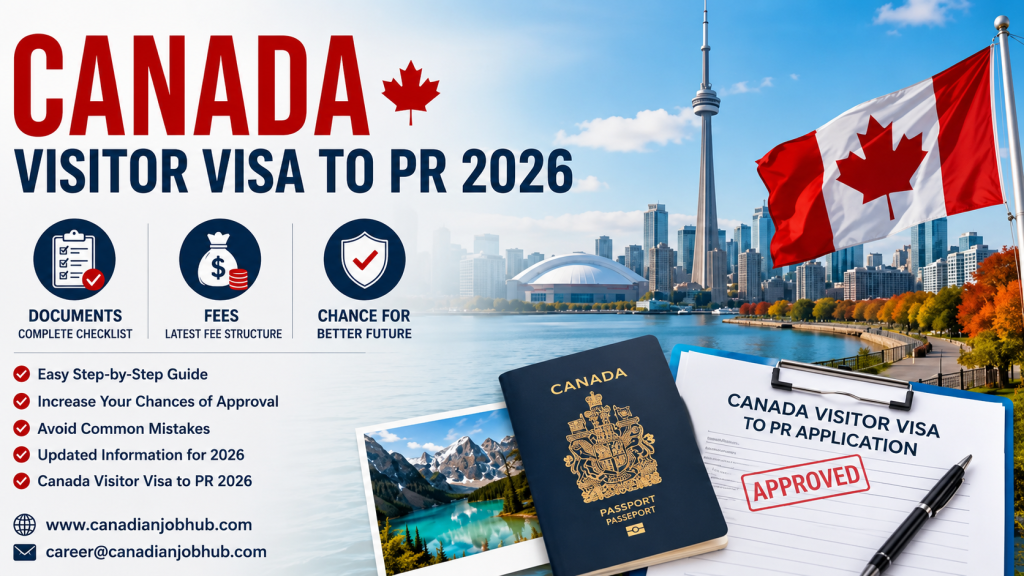
Canada Visitor Visa to PR
Canada remains one of the world’s most attractive destinations for immigrants seeking better career opportunities, high-quality education, universal healthcare, and an excellent standard of living. Every year, millions of visitors travel to Canada for tourism, family visits, business meetings, or short-term stays. One of the most frequently asked immigration questions is:
Can I convert my Canada Visitor Visa into Permanent Residency (PR)?
The answer is yes—but not directly.
A visitor visa itself does not automatically lead to permanent residence. However, it can become the starting point for several legal immigration pathways that eventually allow eligible individuals to obtain Canadian PR.
In 2026, Canada continues to offer multiple immigration programs for skilled workers, graduates, entrepreneurs, caregivers, and provincial nominees. If you are already in Canada on a visitor visa or planning to visit, understanding these pathways can significantly improve your chances of settling permanently.
This complete guide explains everything you need to know about moving from a Canada Visitor Visa to Permanent Residency in 2026, including eligibility requirements, application procedures, work permit options, common mistakes, and expert tips to maximize your success.
What is a Canada Visitor Visa?
A Canada Visitor Visa, officially called a Temporary Resident Visa (TRV), allows foreign nationals to visit Canada temporarily for purposes such as:
- Tourism
- Family visits
- Business meetings
- Medical treatment
- Short-term studies
- Conferences
- Events
Visitor visas generally allow stays of up to six months, although the final duration is determined by the border officer upon arrival.
Click Here: Trades Jobs in Canada 2026 Skilled Trades Careers, LMIA & Work Visa Guide
Can You Get PR While on a Visitor Visa?
Yes.
Many immigrants successfully obtain Permanent Residence after entering Canada as visitors.
However, the PR application must be made through one of Canada’s official immigration programs.
Simply holding a visitor visa does not guarantee PR approval.
Popular Canada PR Pathways for Visitor Visa Holders
Several immigration programs accept applications from people who are already inside Canada.
1. Express Entry
Express Entry remains Canada’s fastest immigration program.
It manages applications under:
- Federal Skilled Worker Program
- Canadian Experience Class
- Federal Skilled Trades Program
Applicants receive points based on:
- Age
- Education
- Work experience
- Language proficiency
- Job offer
- Provincial nomination
Candidates with the highest CRS scores receive Invitations to Apply (ITA).
2. Provincial Nominee Program (PNP)
Every Canadian province operates its own immigration streams.
Popular provinces include:
- Ontario
- Alberta
- Saskatchewan
- British Columbia
- Manitoba
- Nova Scotia
- New Brunswick
If a province nominates you, your chances of receiving PR increase significantly.
3. Employer-Sponsored Work Permit
Many visitor visa holders search for jobs after arriving in Canada.
If an employer offers employment and receives a positive Labour Market Impact Assessment (LMIA), you may qualify for a work permit.
Canadian work experience later improves your eligibility for permanent residence.
4. Atlantic Immigration Program
This program targets skilled workers who wish to live in:
- Nova Scotia
- New Brunswick
- Prince Edward Island
- Newfoundland and Labrador
Applicants usually require:
- Job offer
- Employer endorsement
- Settlement plan
5. Rural Community Immigration Programs
Canada also supports immigration into smaller communities experiencing labour shortages.
These programs help skilled foreign workers settle outside major cities.
6. Caregiver Programs
Qualified caregivers may qualify for permanent residence after gaining eligible Canadian work experience.
7. Business Immigration
Entrepreneurs and investors can pursue PR through provincial entrepreneur streams and business immigration programs.
Can Visitor Visa Holders Apply for Work Permits?
Yes, in many situations.
Depending on government policies and your eligibility, visitor visa holders may apply for employer-specific work permits while remaining inside Canada.
Requirements generally include:
- Genuine job offer
- Eligible employer
- Supporting documents
- Meeting immigration requirements
A work permit often becomes the first major step toward permanent residence.

Benefits of Moving from Visitor Visa to PR
Permanent Residents enjoy numerous advantages:
- Live anywhere in Canada
- Work for almost any employer
- Access public healthcare
- Free education for children
- Social benefits
- Pathway to Canadian citizenship
- Sponsor eligible family members
- Greater job opportunities
- Long-term security
Eligibility Requirements
Eligibility depends on the immigration pathway chosen.
Common requirements include:
Education
Most skilled immigration programs require:
- Bachelor’s degree
- Diploma
- Master’s degree
- Educational Credential Assessment (ECA)
Language Skills
Applicants usually take:
- IELTS General
- CELPIP
- TEF Canada (French)
Higher scores increase CRS points.
Work Experience
Applicants typically require skilled work experience under Canada’s National Occupation Classification (NOC).
Medical Examination
Applicants must complete immigration medical exams from approved panel physicians.
Police Clearance
Police certificates are generally required from countries where applicants have lived for extended periods.
Proof of Funds
Many programs require evidence that applicants can financially support themselves after immigration.
Step-by-Step Process
Step 1
Enter Canada legally using a valid Visitor Visa.
Step 2
Research immigration programs suitable for your profile.
Step 3
Improve English or French language scores.
Step 4
Obtain Educational Credential Assessment (ECA).
Step 5
Prepare documents including:
- Passport
- Education certificates
- Employment letters
- Language test results
- Police certificates
- Financial documents
Step 6
Create your Express Entry profile or apply through another immigration stream.
Step 7
Receive Invitation to Apply (ITA) or provincial nomination.
Step 8
Submit complete PR application.
Step 9
Complete biometrics and medical examination.
Step 10
Receive Confirmation of Permanent Residence (COPR).
Documents Required
Don’t miss these trending job opportunities in 2026. Visit: 🌐www.canadianjobhub.com/ or send your updated CV to Apply Now. 📨career@canadianjobhub.com
Typical documents include:
- Passport
- Visitor Visa
- Birth Certificate
- Marriage Certificate (if applicable)
- Educational Credentials
- ECA Report
- IELTS/CELPIP Results
- Employment Letters
- Resume
- Police Clearance Certificates
- Medical Examination
- Proof of Funds
- Digital Photographs
Jobs That Increase PR Chances
High-demand occupations include:
- Registered Nurses
- Software Developers
- Data Scientists
- AI Engineers
- Electricians
- Welders
- Construction Managers
- Civil Engineers
- Accountants
- Truck Drivers
- Healthcare Assistants
- Early Childhood Educators
- Cybersecurity Specialists
- Agricultural Workers
- Hospitality Professionals
Common Mistakes to Avoid
Avoid these errors:
- Overstaying your visitor status.
- Working without authorization.
- Providing inaccurate information.
- Missing application deadlines.
- Ignoring language requirements.
- Applying under the wrong immigration stream.
- Submitting incomplete documentation.
- Assuming a visitor visa automatically leads to PR.
Tips to Improve Your PR Chances
- Achieve high IELTS or CELPIP scores.
- Obtain Canadian job offers.
- Gain Canadian work experience.
- Improve educational qualifications.
- Apply through Provincial Nominee Programs.
- Learn French for additional CRS points.
- Keep immigration documents updated.
- Monitor immigration policy changes regularly.
Processing Time
Processing varies depending on the immigration program.
Approximate timelines:
| Program | Estimated Processing Time |
|---|---|
| Express Entry | 6–8 months |
| Provincial Nominee Program | 8–18 months |
| Atlantic Immigration | 6–12 months |
| Family Sponsorship | 10–24 months |
| Caregiver Programs | Varies |
Processing times may change based on application volume and immigration priorities.
Is Canada Still Accepting New Permanent Residents in 2026?
Yes.
Canada continues welcoming skilled immigrants through multiple federal and provincial programs to address labour shortages, support economic growth, and strengthen communities. Applicants with in-demand skills, strong language proficiency, and valid job offers often have competitive opportunities to obtain permanent residence.
More Opportunities:
- Trades Jobs in Canada 2026 | Skilled Trades Careers, LMIA & Work Visa Guide
- IT Jobs in Canada 2026: Software Developer, Data Scientist & AI Engineer
- Canada Tech Talent Strategy 2026 Accelerated Work Permits for US H-1B Holders
- Canada PR Pathway 2026: Complete Guide to Permanant Residency
- Canada Work Visa Apply Online 2026: Complete Step-by-Step Guide for Foreign Workers
- Canada New Immigration Policy 2026 – Latest Rules, PR, Work Permit & Visa Guide
- Top 10 In-Demand Jobs in Canada 2026: High-Paying Careers, LMIA & Visa Sponsorship Guide
- Canada Provincial Nominee Program (PNP) 2026: Complete Guide to Apply & Get Permanent Residency
- Canada Provincial Nominee Program (PNP) 2026: Complete Guide to Apply & Get Permanent Residency
- Austria Job Seeker Visa Explained (Easy Guide 2026)
- Canada Hotel Jobs for Foreigners 2026: Complete Guide to Work and Build a Career in Canada’s Hospitality Industry
- Germany Opportunity Card Explained (Latest Update 2026)
- Top 20 Canada Interview Questions for Foreign Workers (2026 Guide)
- Germany Work Visa 2026: Complete Process & Requirements for Foreign Workers
- Canada Seasonal Worker Visa Process 2026 – Complete Step-by-Step Guide for Foreign Workers
- How to Get a Schengen Work Visa in 2026 (Step-by-Step Guide)
- Urgent Canada Farm Worker Jobs 2026 – Apply Now with Visa Sponsorship
- How to Get an Oman Visa Without an Agent 2026.
- LMIA Jobs in Canada 2026: Complete Guide to Visa Sponsorship, Work Permits & High-Demand Careers
Frequently Asked Questions (FAQs)
1. Can I apply for PR while on a visitor visa in Canada?
Yes. You can apply for permanent residence through eligible immigration programs while maintaining valid visitor status.
2. Does a visitor visa automatically become PR?
No. A visitor visa is temporary and does not automatically lead to permanent residency.
3. Can I work in Canada on a visitor visa?
No. You generally need a valid work permit before you can legally work in Canada.
4. Which PR program is best for visitor visa holders?
Express Entry and Provincial Nominee Programs (PNPs) are among the most popular options, depending on your qualifications.
5. Can my family apply with me for PR?
Yes. Eligible spouses, common-law partners, and dependent children can usually be included in your permanent residence application.
Conclusion
A Canada Visitor Visa does not automatically convert into Permanent Residency, but it can serve as the first step toward achieving your long-term immigration goals. By exploring pathways such as Express Entry, the Provincial Nominee Program (PNP), employer-sponsored work permits, the Atlantic Immigration Program, and other skilled worker streams, eligible visitors can build a strong foundation for becoming permanent residents.
Success depends on careful planning, maintaining valid immigration status, improving language proficiency, preparing complete documentation, and selecting the immigration program that best matches your qualifications and career goals. Staying informed about the latest immigration policies and acting within legal requirements will significantly improve your chances of success.
If your goal is to live, work, and settle in Canada permanently, 2026 offers valuable opportunities for skilled professionals, international workers, and their families. With the right strategy and preparation, your journey from visitor to permanent resident can become a reality.